Safety & Navigation
How to Navigate With a Map and Compass
Learn how to use a map and compass to navigate trails confidently. This beginner's guide covers compass parts, topo maps, taking a bearing, and declination.
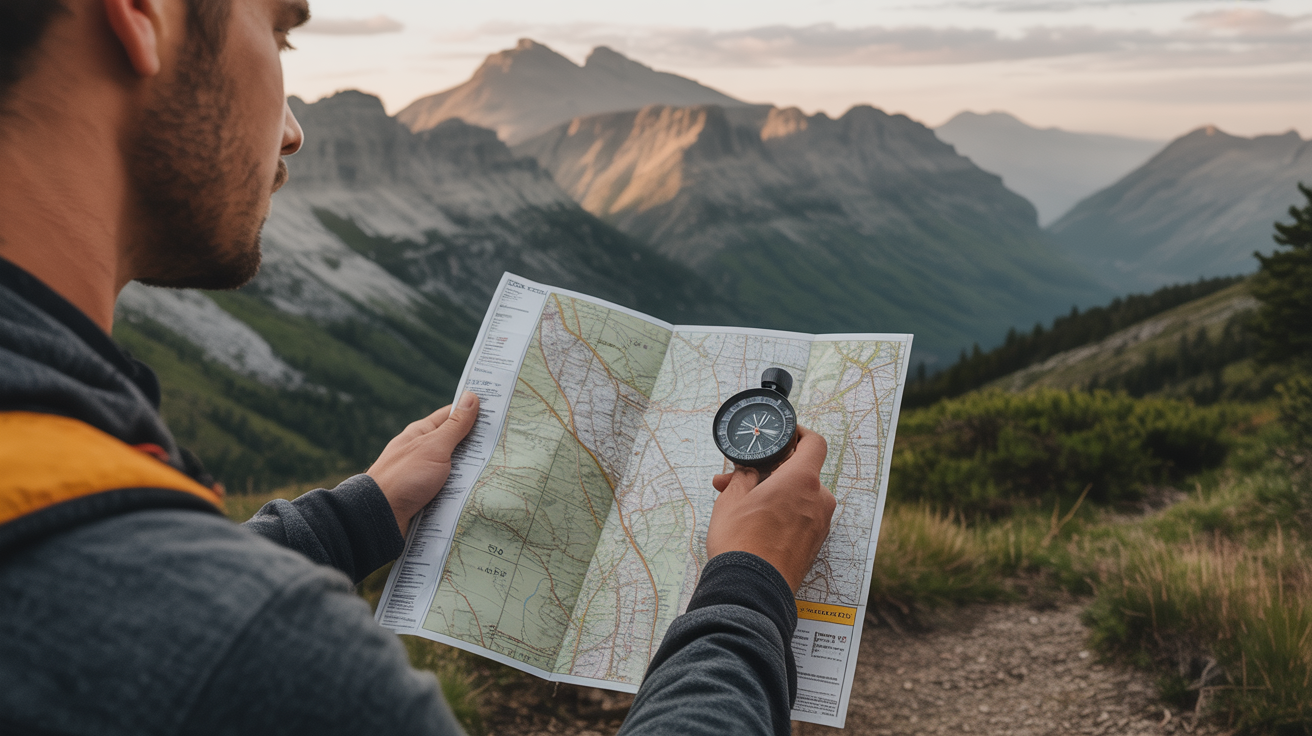
Paper maps and a baseplate compass cost about $30 combined. They work at -20°F, in a canyon with no cell signal, and after you drop them in a creek. That's why every hiker, even one with a fully charged smartphone, should know map and compass basics before heading into unfamiliar terrain.
This guide walks you through everything from identifying the parts of a compass to accounting for magnetic declination. By the end, you'll be able to orient a map, take a bearing to a landmark, and follow that bearing through the woods.
The Parts of a Compass (and What They Do)
Before you can use a compass, you need to know what you're holding. A standard baseplate compass (also called an orienteering compass) has several distinct parts.
| Part | What It Does |
|---|---|
| Baseplate | The clear rectangular plate; has rulers along the edges for measuring map distances |
| Direction-of-travel arrow | Printed on the baseplate; points the way you'll walk |
| Rotating bezel (dial) | The ring you twist; marked in degrees 0–360 |
| Orienting lines | Lines inside the bezel; you align these with map meridians |
| Orienting arrow | Inside the bezel; you rotate the bezel until the magnetic needle "boxes" inside this arrow |
| Magnetic needle | The part that actually moves; red end points to magnetic north |
| Index line | Where the bezel meets the baseplate; this is where you read your bearing |
The key relationship to internalize: the red needle always seeks magnetic north. You use the bezel to translate that into a usable direction.
Reading a Topographic Map
A topographic (topo) map shows terrain in three dimensions using contour lines. Once you can read those lines, the map tells you whether the trail climbs a ridge, crosses a valley, or skirts around a steep face.
Contour Lines
Each contour line connects points at the same elevation. The contour interval (usually printed in the map's legend) tells you how much elevation change separates each line. If the interval is 40 feet and you count five lines between two points, that's a 200-foot climb.
A few rules:
- Lines close together = steep terrain
- Lines far apart = gentle slope
- A circle of lines = a hilltop or depression (check the legend for depression symbols)
- Lines that form a V pointing uphill = a valley or drainage
Map Scale
The scale ratio (for example, 1:24,000) means one inch on the map equals 24,000 inches on the ground. The ruler on your baseplate lets you measure map distances and convert them using the scale bar in the legend.
Grid Lines and True North
Most USGS topo maps are oriented with true north at the top. The vertical grid lines running up the map are your reference for aligning a compass bearing. You'll come back to these when you take a bearing.
Why Phones Aren't Enough on Their Own
Your phone does a lot. But it has a battery, a screen that washes out in bright sun, and cellular or GPS signal that can drop in deep canyons or dense tree cover. A downloaded offline map helps, but if the phone dies or the screen cracks, you're done.
A compass has no battery. A paper map doesn't freeze or overheat. Using your phone for hiking navigation is a smart supplement, not a replacement.
Carry both. Use the phone for convenience; rely on the map and compass when it matters.
How to Orient Your Map
Orienting the map means rotating it so north on the map matches north in the real world. Once the map is oriented, features you see around you (a ridgeline, a lake, a road) should correspond to their positions on the map.
- Set the bezel to 0° (or "N").
- Lay the compass on the map with the baseplate edge along a vertical north-south grid line.
- Hold the map and compass together, then slowly rotate your body (not the compass) until the red needle aligns with the orienting arrow.
- The map is now oriented. A hill on your left in real life should appear on the left side of the map.
Practice this in a parking lot or a park before you rely on it in the backcountry.
Taking and Following a Bearing
A bearing is a direction expressed in degrees (0–360). North is 0°, east is 90°, south is 180°, west is 270°. Taking a bearing to a landmark lets you walk toward it even when it disappears from sight.
Step-by-Step: Taking a Bearing from Map to Field
- Mark your position and your destination on the map.
- Place the compass on the map so one long edge of the baseplate connects your position to your destination, with the direction-of-travel arrow pointing toward your destination.
- Rotate the bezel until the orienting lines inside it run parallel to the map's north-south grid lines (orienting arrow pointing to map north).
- Read the bearing at the index line. That number is your bearing, but before you use it, you need to correct for declination (see the next section).
- After adjusting for declination, hold the compass level in front of you and rotate your body until the red needle sits inside the orienting arrow.
- Look up along the direction-of-travel arrow and pick a landmark in that direction, a distinct tree, a boulder, a gap in the ridgeline.
- Walk to that landmark, then repeat: pick another landmark along the same bearing and walk to it.
This technique (picking interim landmarks) is called "aiming off" or "leapfrogging," and it keeps you from constantly staring at the compass while you walk.
Declination: Magnetic North vs. True North
This is the part that trips up most beginners, so here's the simple version.
Your compass points to magnetic north, which is not the same as true north (the geographic North Pole). The difference between them, measured in degrees, is called declination. It varies depending on where you are in the world, and it changes slowly over time.
In the western United States, declination is typically 10–15° east, meaning magnetic north is east of true north. In the eastern US, it's often 10–15° west. USGS topo maps print a declination diagram in the corner showing the exact value for that map's area.
How to Correct for Declination
Most baseplate compasses let you set a declination correction directly on the bezel using a small screwdriver adjustment. Set it once for your region and forget it, the compass handles the math.
If your compass doesn't have this feature:
- East declination: subtract degrees from your magnetic bearing to get a true bearing, or add when going from map to compass.
- West declination: add degrees to your magnetic bearing to get a true bearing, or subtract when going from map to compass.
A common memory aid: "East is least (subtract), West is best (add)", meaning east declination reduces the bearing you use.
Getting declination wrong by even 10° can put you hundreds of feet off course over a mile. It's worth spending five minutes on this before your trip. The National Oceanic and Atmospheric Administration (NOAA) maintains a free declination calculator at ngdc.noaa.gov where you can look up today's value for any location.
Putting It Together on the Trail
Map and compass navigation isn't just for emergencies. Using it regularly, even on marked trails, builds the habit of knowing where you are at all times.
A simple routine:
- At every junction or notable feature, check your position on the map.
- Note landmarks ahead and identify them on the map.
- Estimate how long it will take to reach the next landmark based on distance and elevation change.
If you do get disoriented, the map and compass give you a starting point for a systematic search rather than random wandering. Pair this skill with what to do if you get lost, covered in our guide on what to do if you get lost while hiking.
Before any trip into new terrain, also check how to read the weather before a trip, conditions on the map look very different from conditions on the ground when a storm rolls in.
Practice Before You Need It
The worst time to learn compass navigation is when you're already unsure where you are. Practice in a place you know well first.
Go to a local park or neighborhood with a clear landmark visible in the distance. Take a bearing to it from where you're standing, walk 100 yards while following the bearing, then check whether you're still aimed correctly. Do this a dozen times and the process becomes automatic.
Then graduate to a short hike on a marked trail where you can confirm your map position at every intersection. By the time you're in the backcountry relying on a bearing, the mechanics should feel routine.
Frequently Asked Questions
How accurate is a baseplate compass?
A quality baseplate compass is accurate to within 1–2 degrees if held level and kept away from metal objects, phones, and car bodies. At 1 mile, a 2° error puts you about 185 feet off course, acceptable for most trail navigation but worth accounting for in featureless terrain.
Do I need a special compass for hiking?
A basic orienteering baseplate compass works fine for most hiking. Look for one with a rotating bezel marked in 2° increments, a clear baseplate with a ruler, and an adjustable declination setting. Brands like Suunto, Silva, and Brunton make reliable models starting around $15–$30.
Can I use a compass near my phone?
Keep the compass at least 6–12 inches away from your phone, metal belt buckles, and car doors. Nearby metal and electronics can deflect the needle and give you a false reading.
What if I can't find north on my map?
USGS topo maps always have north at the top, with a declination diagram in the bottom margin. If you're using a trail map from a park brochure, look for a north arrow or compass rose. If none exists, that map isn't suited for serious navigation.
How long does it take to learn map and compass navigation?
The basics, orienting a map, taking a bearing, correcting for declination, can be learned in an afternoon. Becoming comfortable enough to trust your navigation in unfamiliar terrain takes several practice sessions over a few weeks. Start simple, build the habit, and your confidence grows quickly.