Hiking & Trails
Do You Need Trekking Poles? A Beginner's Guide
Trekking poles reduce knee strain, improve balance, and help with stream crossings. Here's when they're worth it and how to choose your first pair.
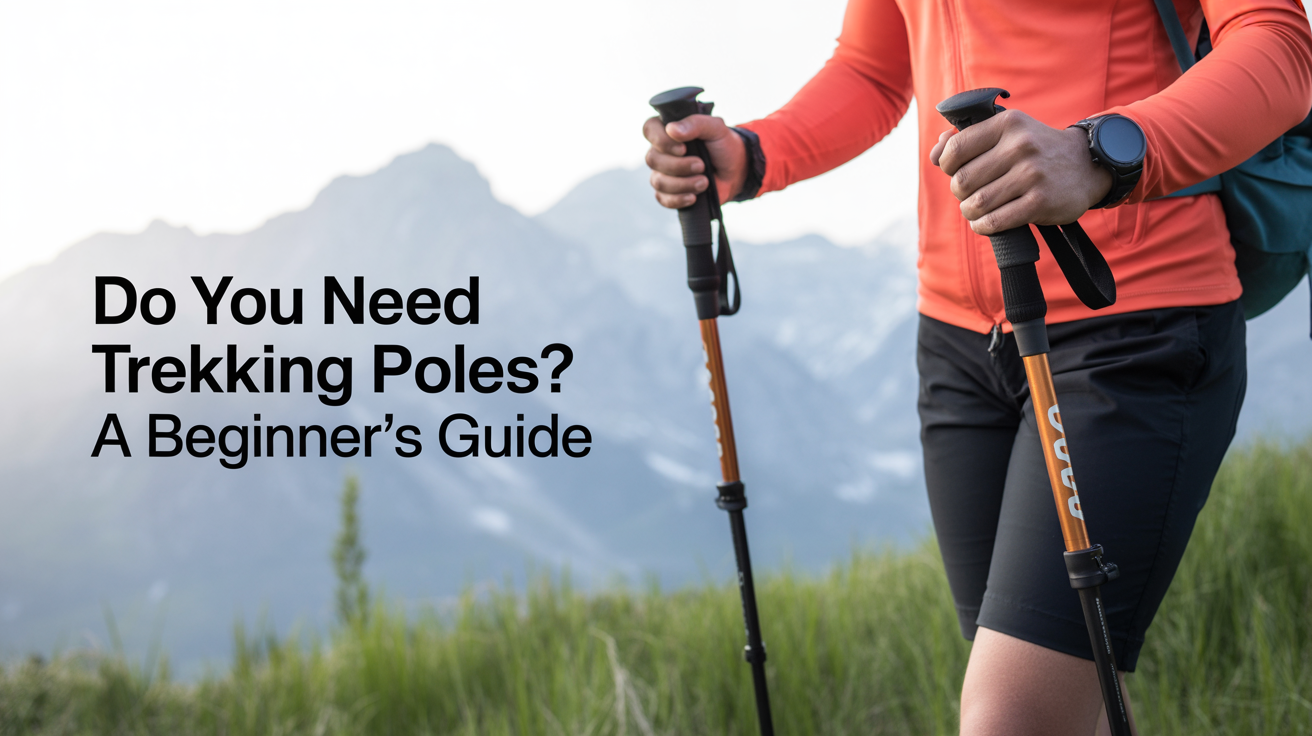
Short answer: no, you don't need trekking poles. Millions of people hike perfectly well without them. But on certain terrain, especially long descents with a loaded pack, poles make a real difference in how your knees feel the next morning.
Here's how to figure out whether they're worth adding to your kit.
What Trekking Poles Actually Do
Poles aren't just for looking experienced. They serve a few concrete mechanical purposes.
Knee protection on descents. Going downhill, especially with a pack, puts significant load on your knee joints. Each step is a controlled fall, and your quads and knees absorb it. Poles let you share some of that load with your arms and upper body, which helps over a long descent.
Balance on uneven ground. Loose rock, wet roots, and off-camber trail all challenge your balance. Two extra contact points with the ground give you more stability. This matters more as you gain experience and start tackling more technical terrain.
Stream crossings. Poles are genuinely useful here. A single pole planted upstream helps you push against the current and probe depth before committing your foot.
Flat and uphill travel. On flat ground or uphill, poles help with rhythm and can engage your upper body, which takes some load off your legs. The benefit is smaller than on descents, but it adds up on long days.
When You Can Skip Them
Poles are gear with trade-offs. They cost money, occupy your hands, and add weight and pack volume. You probably don't need them if:
- You're doing short day hikes (under 5 miles) on maintained trails with modest elevation change
- The trail is wide and smooth, with no technical sections
- You don't have existing knee problems
- You're not carrying a heavy pack
If you're just getting started with hiking, skip the poles on your first few outings. Learn how the terrain and your own legs feel without them. Then decide.
How to Size and Adjust Poles Correctly
An incorrectly sized pole is worse than no pole. Here's the basic setup:
Finding your handle height. Stand upright on flat ground and grip the pole. Your elbow should be at roughly 90 degrees. Adjust from there: go a bit shorter for uphill sections (your body is more upright), a bit longer for downhill (you need more reach in front).
The wrist strap. Thread your hand up through the strap from underneath, then grip the handle. This way you can relax your grip and let the strap carry some load without dropping the pole. Don't skip this step.
Telescoping adjustment. Most poles adjust via a twist-lock or a lever-lock (flip-lock) mechanism. Lever-locks tend to hold more reliably on technical terrain. Before you head out, test that your poles are locked at the right length and won't slip under pressure.
Planting technique. On flat and uphill ground, plant the pole just behind your leading foot and push back as you step forward. On descents, plant it ahead of you for support before stepping down.
What to Look for in a First Pair
You don't need carbon-fiber ultralight poles for your first season. Here's what matters:
Material. Aluminum poles are heavier than carbon but more durable. If you drop them, they bend rather than snap. For beginners who don't yet know how rough they are on gear, aluminum is the smarter starting point.
Adjustability. A fixed-length pole requires knowing your exact sizing. An adjustable pole lets you dial it in and share it between hikers of different heights. Get adjustable.
Locking mechanism. Lever-locks (flip-locks) are generally more reliable than twist-locks and easier to adjust on the trail with gloves or cold hands.
Tips. Poles come with carbide or steel tips, which grip rock and hardpack well. For trails with paved sections or stone surfaces, use rubber tip covers. This protects the tip, reduces noise, and prevents damage to surfaced paths. It's also the Leave No Trace consideration: bare carbide tips dig into soft ground and can scratch stone. Carry a set of rubber covers and use them where the surface calls for it.
Price range. Reasonable beginner pairs run $40 to $80. Above that, you're mostly paying for lighter weight. Below $30, locking mechanisms tend to be flimsy.
Check what your kit includes before buying. If your day hike gear is already over budget, rent poles from an outfitter first to see how you like them.
Hiking Poles vs Trekking Poles: Is There a Difference?
The terms are used interchangeably by most people, including most manufacturers. Technically, some distinguish "trekking poles" as designed for multi-day use with heavier loads, and "hiking poles" as lighter options for day hikes. In practice, the product categories overlap almost completely. Don't let the naming trip you up.
Walking sticks and wooden staffs are a third option: free, low-tech, and fine for casual trail use. They don't collapse for storage and offer no wrist strap support, but for easy terrain they work.
Frequently Asked Questions
Do trekking poles help with bad knees? They can. Poles reduce the load on your knees during descents, which is where most trail-related knee pain originates. If you already have knee issues, poles are worth trying before you decide hiking isn't for you. That said, existing knee problems deserve a conversation with a doctor, not just a gear purchase.
Do I need one pole or two? Two poles give you symmetrical support and work better for balance and descents. One pole, often a staff, can work for light use, but two is the standard for most hikers.
Can I use ski poles instead? In a pinch, yes. Ski poles are often close to the right length and have a similar grip. The tips aren't ideal for trail surfaces, and the baskets are too large for most trail conditions, but for occasional use it's worth trying what you have before buying.
How do I keep poles from being annoying on easy sections? Collapse them and clip them to your pack. Most packs have webbing loops or gear attachment points for this. It takes about 30 seconds and means you're not fighting with poles on flat, simple trail.
Do I need special footwear if I use poles? No. Poles are independent of your footwear choice. If you're still figuring out how to choose hiking boots or shoes, sort that out first, then revisit poles once you've got more trail time under your belt.